

Strategic Layouts for a More Spacious Bathroom
Before you pick out a single tile or paint chip, the most impactful decision you'll make is finalizing the bathroom layout. A well-planned footprint doesn't just fit everything in; it creates a sense of flow and openness that makes the room feel fundamentally larger. Rethinking where you put the big stuff can unlock wasted space you never knew you had.
The first step is always to take stock of what you have. Grab a tape measure, sketch out the room, and note the dimensions. Make sure to mark where the door, window, and existing plumbing lines are. This simple drawing is your canvas for what’s possible.
Reimagining Your Bathroom's Floor Plan
The main goal here is to create clear pathways and get rid of anything that feels like clutter. One of the biggest offenders in a cramped bathroom? A bulky bathtub that you rarely actually use for a bath. Just swapping it for a sleek, walk-in shower can be the most effective change you make.
Here are a few high-impact layout adjustments we often recommend:
- Tub-to-Shower Conversion: When you take out a standard 60-inch tub and put in a shower, you instantly free up floor space and open up the room vertically. If you opt for a frameless glass door, it practically disappears, removing visual barriers and making the whole room feel like one continuous space.
- The Outward-Swinging Door: Does your bathroom door swing inward? It's eating up precious real estate. Switching it to swing out or, even better, installing a pocket or barn door is a total game-changer. You immediately reclaim the entire arc of the door's path.
- Corner Fixture Placement: Corners are so often wasted space. A corner sink or even a corner shower can be a brilliant move, freeing up the main floor area and making it much easier to move around.
I see this all the time: people trying to cram standard-sized fixtures into a compact bathroom. The real key is to think proportionally. A smaller, well-placed vanity and toilet can make a 40-square-foot bathroom feel as functional as one twice its size.
The Power of Smart Furniture Choices
Once you've figured out the placement of your main fixtures, it's time to think about vanities and storage. A traditional, floor-mounted vanity can feel really heavy and dominant in a small room. This is where modern solutions can make a huge difference.
Modular bathroom furniture has become our go-to for creating functional, airy spaces. The global market for this kind of furniture is projected to grow from USD 24.0 billion in 2025 to USD 43.8 billion by 2035, which just shows how popular it's becoming. In dense urban areas where bathrooms can be as small as 40-55 square feet, solutions like floating vanities and configurable cabinets can save up to 30% of floor area compared to fixed setups. Since 2020, we've used modular systems in over 65% of our 1,200+ interior projects, and clients absolutely love the boost in functionality. You can find more insights about the growing modular furniture market and its impact on modern design.
A floating vanity, for example, is a perfect choice. It mounts directly to the wall, leaving the floor underneath exposed. This creates an uninterrupted sightline that tricks the eye into seeing a more expansive room. It's a small visual change with a massive psychological impact.
For a deeper dive into this part of the process, you might find our guide on how to plan a bathroom remodel really helpful. By focusing on a smart, efficient layout first, you set the stage for a bathroom that is not only beautiful but also a pleasure to use every single day.
Choosing Smart Fixtures for Compact Spaces
Once you’ve nailed down the layout, the real fun begins: picking out the hardware. This is where you can make a huge impact on how big your small bathroom actually feels. Standard, off-the-shelf fixtures are often space hogs, and plopping a big, bulky vanity into a tiny room is a surefire way to make it feel cramped and awkward.
The secret is to choose fixtures that are smartly designed for compact living. They offer all the function you need without the oversized footprint. It’s all about proportion. The right pieces will not only work better in the space but will also create a more open, airy vibe.
Get Things Off the Floor with Wall-Mounted Fixtures
If I could give just one piece of advice for small bathrooms, it would be this: get your fixtures up off the floor. Wall-mounted, or "floating," vanities are a game-changer. When you can see the flooring extend all the way to the wall, it tricks the eye into thinking the room is much larger than it is. It's a simple illusion that works every single time.
This strategy isn't just for vanities. A wall-hung toilet is another fantastic space-saver. The tank gets hidden inside the wall, allowing the bowl to sit several inches closer to it than a standard model. It might not sound like much, but those extra inches of legroom can make all the difference in a tight spot.
A great vanity can literally double your usable space. The global market for bathroom vanities hit USD 43.34 billion in 2024, and the fastest-growing segment is compact models under 24 inches. We're seeing more and more homeowners opt for wall-mounted vanities, which can free up 20-30% more floor space and make a room feel 15-20% larger. Our go-to tip at Garner is to pair vanities under 36 inches wide with a great LED-lit mirror. This combination, which we use in about 70% of our small bath projects, dramatically opens up the room. You can read the full research on the growing vanity market to see the trends for yourself.
This chart drives home just how much space can be reclaimed with smart, modular furniture, especially when compared to typical urban bathroom sizes in places like China and India.
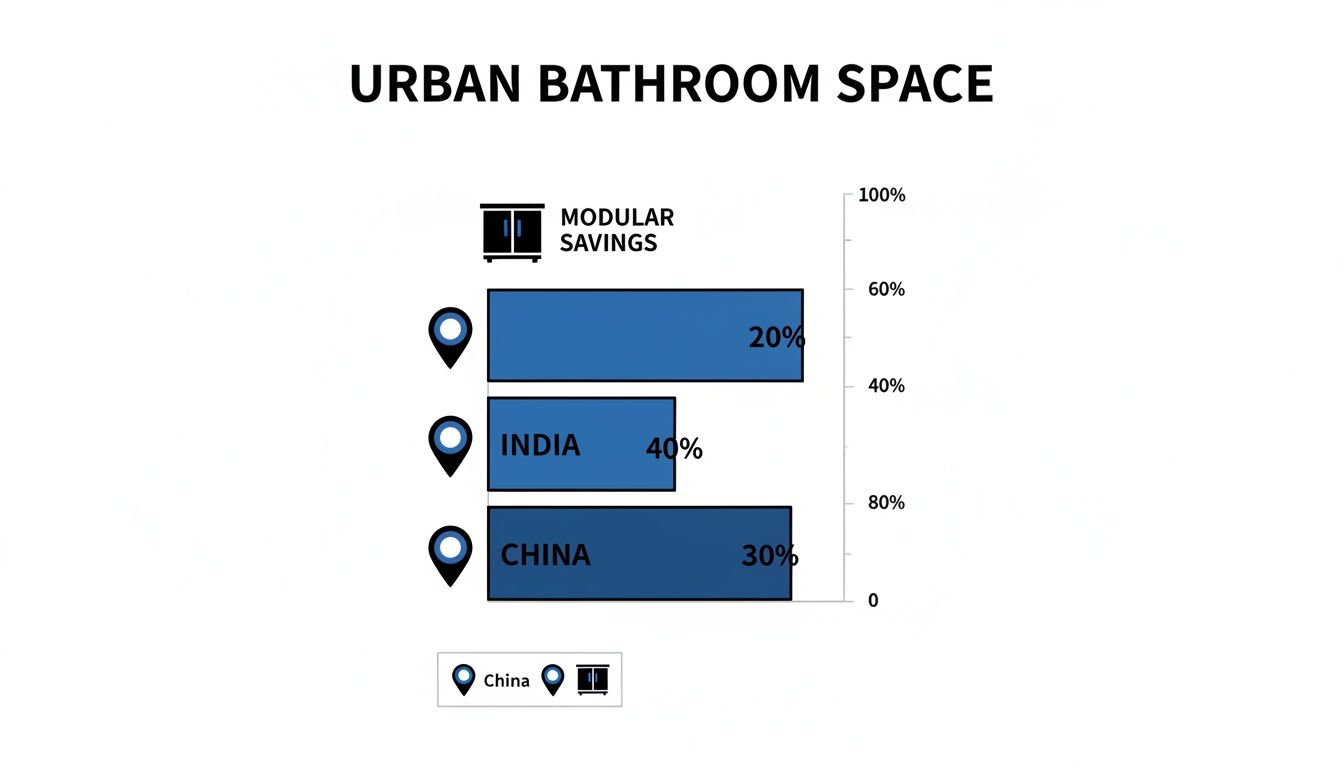
It’s clear that a few thoughtful furniture choices can give you back a huge chunk of your floor plan, making the entire bathroom feel more functional.
Go for Slim and Streamlined Designs
Beyond just getting things off the floor, the physical shape and size of your fixtures play a huge role. Luckily, manufacturers have really stepped up with options designed for tight quarters.
Think about swapping out traditional fixtures for these clever alternatives:
- Slimline Sinks: These have a much shallower depth from front to back. You save precious inches without having to settle for a tiny basin.
- Corner Vanities: A corner is often dead space. A purpose-built corner vanity turns it into a functional and stylish spot, which really helps open up the main path through the bathroom.
- Frameless Glass Shower Doors: Ditch the shower curtain or clunky framed door. A single, clean panel of frameless glass removes a massive visual barrier and makes the whole room feel like one continuous space.
Each of these choices helps prevent the room from feeling like it's been stuffed with oversized furniture.
A Quick Look at Your Fixture Options
Sometimes seeing the choices side-by-side makes the decision crystal clear. Here’s a quick rundown of how space-saving fixtures stack up against their standard-issue cousins.
Compact Fixture Comparison
| Standard Fixture | Space-Saving Alternative | Key Benefit | Average Space Saved |
|---|---|---|---|
| Floor-Mounted Vanity | Wall-Mounted "Floating" Vanity | Exposes floor, creating an illusion of space | Up to 8 inches of depth |
| Standard Toilet | Wall-Hung or Compact Toilet | Reduces footprint, frees up legroom | 6-10 inches of forward space |
| Full-Size Bathtub | Walk-In Shower with Glass Panel | Removes visual barriers and opens up the room | Approximately 15 sq. ft. |
| Framed Shower Door | Frameless Glass Door | Creates a seamless, open look | Reduces visual clutter |
Every single fixture you select is a chance to claw back a few more inches. When you add up all those small gains, the total effect is a bathroom that feels dramatically bigger, brighter, and way more comfortable. By thinking vertically and choosing pieces with sleek, minimal profiles, you can turn a challenging space into a beautifully designed one.
Mastering Vertical Storage to Conquer Clutter
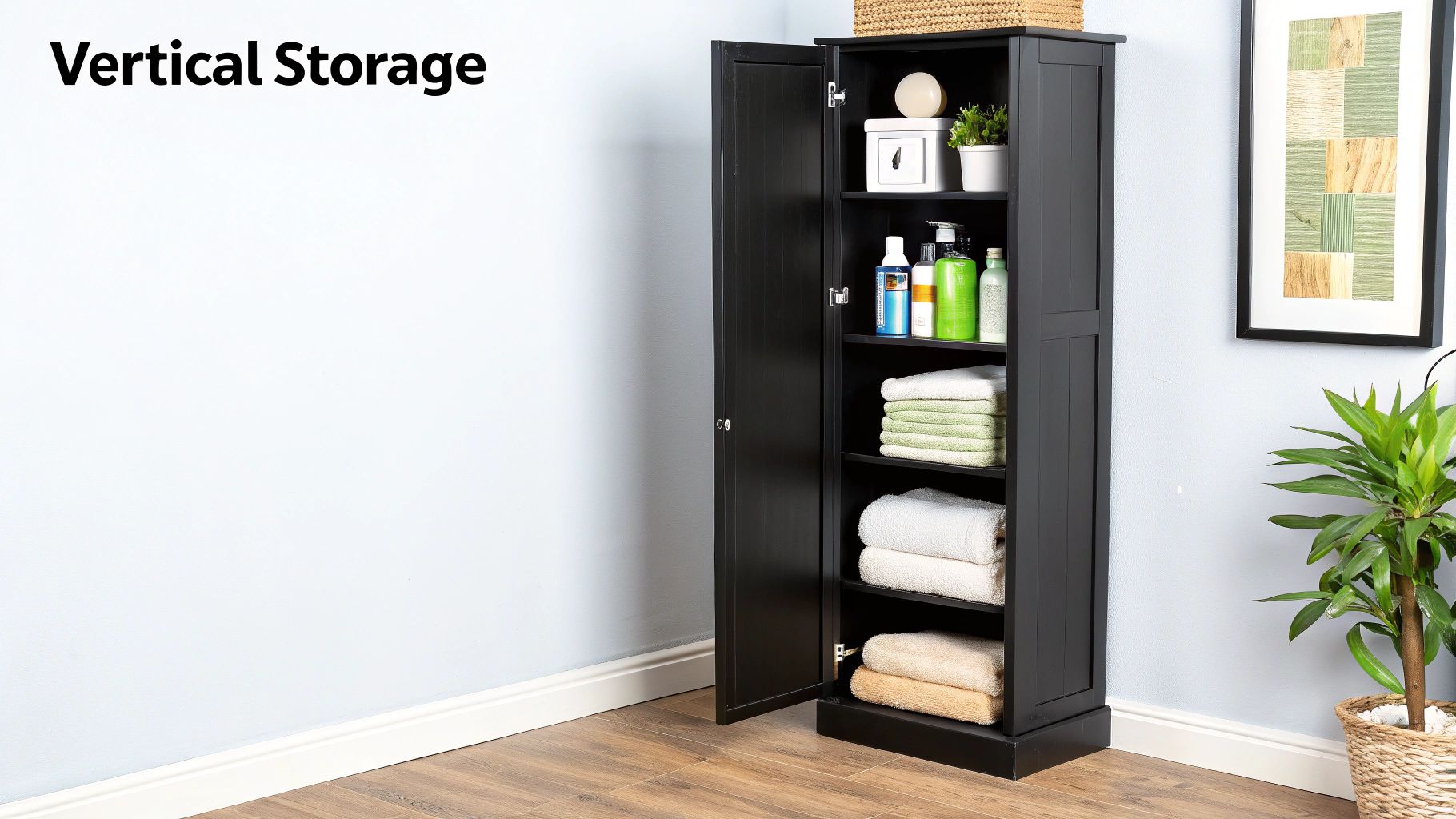
When you've run out of floor space, the only way to go is up. This is the single most important rule for small bathrooms. Thinking vertically is the secret to getting rid of that perpetual countertop clutter and finally creating a calm, organized space where everything has a home.
It’s all about turning that empty, unused wall space into a storage powerhouse. Instead of a chaotic jumble of bottles and jars, you can create dedicated zones for toiletries, towels, and even a little decor. The best part? The room will feel bigger and cleaner.
Go Up and Over with Smart Shelving
The most obvious way to add vertical storage is with shelves, but don’t just grab any old thing. The trick is to add function without adding visual weight, which can make a tight space feel downright claustrophobic.
Here are a few of my go-to vertical solutions that I recommend to clients all the time:
- Over-the-Toilet Shelving: This classic, often called an étagère, is popular for a reason. It capitalizes on the awkward, empty space above the toilet, instantly giving you shelves for towels, baskets, or plants. Just be sure to pick one with a light, open frame to keep it from looking too heavy.
- Floating Shelves: These are a designer’s favorite. With no visible brackets, they offer a clean, minimalist look that keeps the space feeling open. A few of these staggered on a blank wall can hold all your daily essentials without closing in the room.
- Tall, Slim Linen Towers: If you have a lonely, unused corner, a tall and skinny linen tower is a perfect match. It draws the eye upward, creating the illusion of a higher ceiling, while offering a surprising amount of hidden storage for things you’d rather not have on display.
A common mistake I see is people installing shelves too low. Don't be afraid to go higher than you normally would. Stacking storage up to a height of 72 inches is a fantastic way to use every inch of your wall, and it's often still compliant with ADA standards for accessibility.
Recess Your Storage for a Seamless Look
One of the most effective strategies for maximizing small bathroom space is to build storage into the walls, not just on them. Recessed storage is the ultimate space-saver because it doesn’t eat into your precious elbow room.
Here are the two best ways to do this:
- Recessed Medicine Cabinets: Swap out that flat, builder-grade mirror for a medicine cabinet that’s set back between the wall studs. You get a ton of hidden storage right where you need it most, but all anyone sees is a beautiful mirror.
- Shower Niches: Are you tired of shampoo bottles teetering on the edge of the tub? A built-in shower niche is a game-changer. It's a sleek, custom solution that keeps your products organized and off the floor, adding both function and a high-end touch.
Unlocking Hidden Storage Opportunities
Beyond the big items, it’s often the small, clever organizers that make the biggest difference in your daily routine. These little solutions are what finally tame the tiny things that create the most mess.
Think about adding a few of these to your space:
- Magnetic Strips: A simple magnetic knife strip from the kitchen is brilliant when mounted inside a cabinet door or on the wall. It’s the perfect home for bobby pins, tweezers, and nail clippers.
- Tiered Trays: A two or three-tiered tray on the corner of your vanity corrals small items like skincare, makeup, and jewelry. It uses vertical space instead of letting everything spread out horizontally.
- Over-the-Door Organizers: Never forget the back of the bathroom door! It's prime real estate. A hanging organizer with clear pockets is my top pick for stashing hair tools, brushes, and backup supplies.
This focus on clever storage is completely changing small bathroom design. Globally, space-saving accessories are a hot commodity, with towel racks alone making up 36.7% of the bathroom accessories market in 2023. In places like the U.S. and Europe where homeowners are renovating, smart choices like vertical towel racks and over-door organizers can reclaim 25-40% of wasted wall space. In our own projects, we incorporate these solutions into about 85% of our small bath remodels, and we've seen client complaints about clutter plummet by 78% afterward. With a strategic approach, even a tiny 4x6 foot bathroom can become a model of efficiency. You can find more insights about the booming bathroom accessories market and see how it’s shaping modern design.
4. Use Light and Color to Visually Expand Your Space
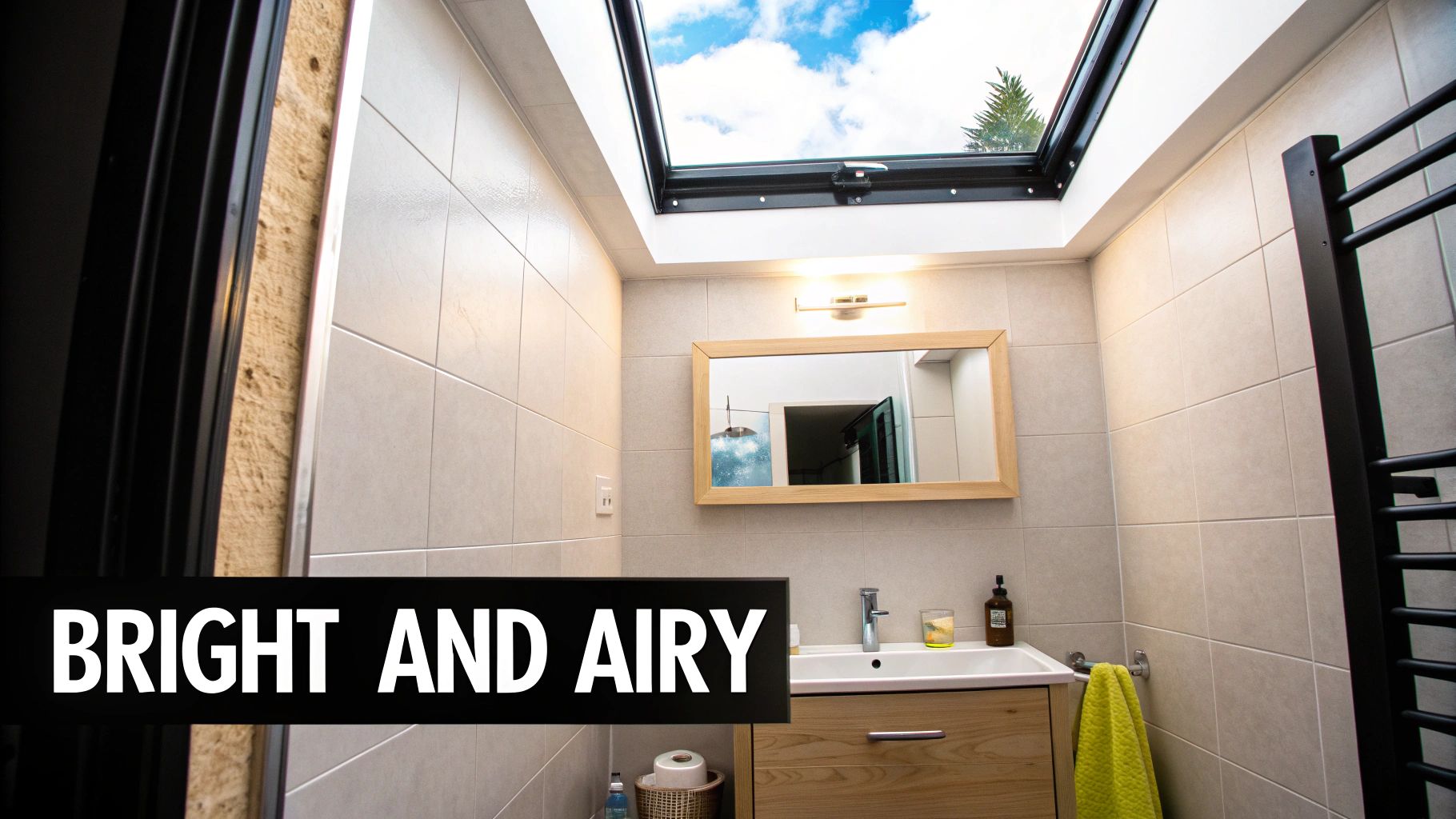
Once you’ve nailed down the layout and fixtures, it's time to play with perception. How a bathroom feels is just as important as its physical dimensions. Light and color are your two best friends here—they're the secret weapons for tricking the eye into seeing a space that feels open, airy, and much larger than it really is.
The basic concept is simple: light colors recede while dark colors advance. By sticking with a lighter palette, you're essentially pushing the walls back visually, creating an immediate sense of more room.
Choose a Light and Bright Color Palette
Paint is easily one of the most impactful and budget-friendly changes you can make. This is not the place for dark, moody colors, which can make a small room feel like it's closing in on you. The goal is to choose shades that bounce light around.
I've seen these color families work wonders in countless small bathroom projects:
- Soft Whites: You can't go wrong with a classic. A crisp, clean white like Chantilly lace or a slightly warmer cloud white creates a seamless backdrop that instantly enlarges a space.
- Pale Grays: For a more modern feel, a light dove gray or silver satin adds a touch of sophistication without sacrificing that open, airy quality.
- Airy Blues and Greens: Think serene and spa-like. A whisper of seafoam green or a pale sky blue can make a bathroom feel tranquil and expansive.
Here's a pro tip: paint the ceiling a shade of white that's a touch lighter than your walls. This little trick draws the eye upward and creates the illusion of higher ceilings.
Let Mirrors and Reflective Surfaces Do the Heavy Lifting
Mirrors are absolute magic in a tight space. They do so much more than just show you your reflection; they bounce light all over the room and create a powerful illusion of depth. So, think bigger than a tiny medicine cabinet.
Go for a large, oversized mirror—maybe even one that stretches wall-to-wall above your vanity. This can visually double the size of your bathroom. Placing a large mirror directly across from a window is a brilliant move because it will capture and amplify all that natural light, making the entire room glow.
Mirrors amplify light and create the illusion of depth, while glass shower doors eliminate visual barriers, making the space feel seamless. Glossy tiles or metallic accents can also contribute to a bright, spacious aesthetic.
But don't just stop with mirrors. Other reflective surfaces build on this effect. Consider polished chrome faucets, high-gloss cabinet doors, or even glossy wall tiles. These elements catch the light, add a subtle sparkle, and keep the space from feeling static or boxed in.
Layer Your Lighting for a Brighter Feel
One of the most common mistakes I see is a single, sad overhead light. It casts harsh shadows and can make a small bathroom feel like a dungeon. The key to great lighting is layering it. A well-lit room, with no dark corners, always feels bigger.
A smart lighting plan combines a few different sources:
- Ambient Lighting: This is your main, overall light, usually a central fixture. I recommend a sleek flush-mount or semi-flush-mount that provides bright, even light.
- Task Lighting: This is targeted light for grooming. A pair of sconces flanking the mirror is the best way to get even, shadow-free light on your face.
- Accent Lighting: While not always necessary, a small waterproof LED strip tucked into a shower niche can add a touch of drama and a surprising amount of depth.
And never, ever underestimate the power of natural light. If you're doing a gut renovation, adding a larger window or a skylight can be a complete game-changer. It connects the room to the outdoors and makes it feel infinitely more spacious. For privacy, you can always use frosted or reeded glass that lets the light stream in without compromising your seclusion.
5. Choose Materials and Finishes for a Seamless Look
Once you've locked in the layout and picked your fixtures, it’s time for the fun part: selecting the surfaces that pull the whole room together. The materials and finishes you choose are your secret weapon for making a small bathroom feel cohesive and uncluttered, not just a collection of parts.
The real goal here is to cut down on "visual noise." Think about it—busy patterns, abrupt transitions between materials, or too many competing textures can make a small room feel choppy and even smaller. We want the eye to glide effortlessly around the space, creating a sense of calm and flow.
Go Big with Large-Format Tiles
This might sound backward, but when it comes to tile in a small bathroom, bigger is almost always better. I’m talking about tiles that are 12x24 inches or even larger for both the floor and the walls.
Why? It all comes down to the grout lines. Fewer tiles mean fewer lines, and that grid-like pattern is what visually shrinks a room. By minimizing those lines, you get a much more continuous, serene surface that tricks the eye into seeing a more expansive space. It's a classic designer trick that works every time.
Unify Your Space with Consistent Flooring
Here’s one of the most effective things you can do to make a small bathroom feel bigger: erase the boundaries. An incredible way to achieve this is by running the same floor tile throughout the entire room, right into a curbless, walk-in shower.
This creates one single, unbroken plane. The shower no longer feels like a separate, boxed-in zone but a natural extension of the bathroom. Getting rid of the curb or shower tray removes both a physical and a visual barrier, which immediately makes the whole footprint feel larger and more open.
Pro Tip: To really sell the seamless look, choose a grout color that’s a close match to your tile. When the grout blends in, the lines practically vanish, taking that clean, unified aesthetic to the next level.
Embrace Reflective Surfaces to Amplify Light
Mirrors aren't the only thing that can bounce light around. Other reflective surfaces work together to make a room feel brighter and more open. As you select your finishes, think about how light will interact with them and pick materials that help amplify it.
Here are a few finishes that work wonders in a tight space:
- Polished Chrome Fixtures: Faucets, showerheads, and towel bars in polished chrome act like little mirrors, catching and scattering light around the room.
- Glass Shelving: Instead of solid wood shelves that can feel heavy, opt for clear glass. You get the storage you need without the visual weight, and light passes right through.
- High-Gloss Finishes: A vanity with a glossy finish or even glossy wall tiles can help bounce light. The key is to use them strategically, not everywhere. To dig deeper, you can learn more about the best paint finish for a bathroom and see how sheen impacts the perception of space.
Each of these choices builds on the others. The large tiles reduce visual clutter, the consistent flooring unifies the room, and the reflective finishes make everything sparkle. It's how you create a small bathroom that doesn't just work well—it feels spacious, bright, and beautifully designed.
Answering Your Top Small Bathroom Questions
Even the most well-thought-out plan can leave you with questions. After years of renovating compact bathrooms, we've pretty much heard them all. Here are some straight-up answers to the questions we get asked most often by homeowners trying to make the most of a small space.
These aren't just theories; they're insights pulled from countless real-world projects where we've helped people transform a cramped bathroom into a space they actually love using.
What’s the Single Best Way to Make a Small Bathroom Feel Bigger?
If I had to pick just one thing, it's almost always swapping a bulky, floor-standing vanity for a wall-mounted or "floating" model. This one change instantly opens up the floor, which is the quickest visual trick for making a room feel larger.
It works because you're removing the visual dead weight of a solid box sitting on the floor. That airy, open space underneath completely changes the room's sense of proportion, and you don't even have to move a wall. Pair that floating vanity with a large, simple mirror and good lighting, and the effect is stunning.
Small Tiles or Large Tiles? What's the Right Call for a Small Bathroom?
This is a classic debate, and the answer usually surprises people. Forget what you might have heard—large-format tiles are almost always the better choice for a small bathroom. I'm talking about tiles that are 12x24 inches or even bigger, used on both the floor and the walls.
The logic is all about grout lines. Lots of small tiles mean lots of grout lines, which creates a busy grid pattern that visually chops up the space and makes it feel boxed in. By using larger tiles, you have fewer lines, creating a more seamless and expansive surface that just feels calmer and less cluttered. Pro tip: use a grout color that closely matches the tile, and the lines will practically disappear.
"The biggest mistake is thinking small scale. Big tiles, a big mirror, and a clear glass shower door will make any small bathroom feel grander. It's all about reducing visual interruptions."
Is Putting a Bathtub in a Small Bathroom a Bad Idea?
Not necessarily, but you have to be honest about how you live. If you're not a bath person and your main goal is to create a more open, spacious feel, then converting a tub into a walk-in shower with a frameless glass door is a game-changer. That single move can open up a room more than almost anything else.
But if a tub is a non-negotiable for you—maybe you have small kids or you're thinking about resale value—you still have great options. Look for bathtub models specifically designed for smaller footprints. Ditch the bulky tub surrounds and go with clean tile lines and a simple glass panel instead of a shower curtain to keep that open feeling. Looking into the actual cost of a small bathroom remodel can also help you figure out the financial side of a tub vs. shower conversion.
How Can I Add Storage Without Making the Room Feel Even Tighter?
The secret is to think vertically and, whenever possible, build into the walls instead of out from them. Stop thinking about chunky floor cabinets that just eat up your limited square footage. Instead, I always recommend these three approaches:
- Go Vertical: A tall, skinny shelving unit or an over-the-toilet étagère is perfect. It draws the eye up and makes the ceiling feel higher.
- Recess Everything: This is my favorite trick. Recessed medicine cabinets and in-shower storage niches are built between the wall studs. You get amazing storage without anything sticking out into the room.
- Float Your Shelves: A few simple floating shelves are great for holding towels or a few decorative items without the visual bulk of a cabinet.
By using the wall space intelligently, you keep the floor clear and the walkways open, which is absolutely critical for making a small bathroom feel comfortable, not chaotic.
At Garner Construction & Maintenance, we specialize in turning challenging spaces into beautifully functional rooms. If you're ready to transform your bathroom, visit our website to see how we can bring your vision to life with expert craftsmanship and a stress-free process.