

If you're looking for the quickest way to budget your painting project, a good interior painting cost estimator is your best friend. As a rule of thumb, you can expect to pay somewhere between $2 to $6 per square foot just for the walls. If you're going for the whole package—walls, trim, and ceilings—a more realistic average is about $4.70 per square foot.
Your Quick Guide to Interior Painting Costs
Before you get out the measuring tape and start agonizing over paint swatches, it's smart to get a feel for the baseline costs. Knowing how pros price their work helps you set a realistic budget right from the get-go. Most quotes are built around the cost per square foot of the surfaces being painted, which is really the most straightforward way to get a quick, reliable estimate.
Understanding Per-Square-Foot Pricing
The price per square foot is the go-to metric for painters, but it's not a one-size-fits-all number. That rate can swing quite a bit based on a few key things:
- Scope of Work: What are you actually painting? A quote for just the walls will always be lower than one that bundles in the ceilings, baseboards, and all the door and window trim.
- Regional Labor Rates: This is the big one. Labor is the largest chunk of any painting bill, and what painters charge in Omaha is going to be very different from what they charge in San Francisco.
- Project Complexity: Got soaring 15-foot ceilings? Ornate crown molding? Walls that look like a roadmap of cracks? All of that requires more time and skill, which pushes the per-square-foot cost up.
Right now, the national average for interior wall painting is running between $2 and $6 per square foot. When you add trim and ceilings to the mix, that figure often settles closer to $4.70 per square foot. For an entire house, the average to paint just the interior walls is about $2.75 per square foot.
So what does that mean for a single room? A standard 10x12 foot bedroom could run you anywhere from a few hundred dollars to over seven hundred, all depending on the factors we just talked about. If you want to dig deeper into the numbers, you can always check out detailed industry reports.
Expert Tip: Think of the per-square-foot price as your starting point. It's the foundational number that gets adjusted up or down based on the reality of your project—from the condition of your walls to the quality of the paint you choose.
Ballpark Estimates by Room Size
To bring these numbers down to earth, it helps to see how they play out in rooms you can actually visualize. The table below gives you a quick reference for what it might cost to paint just the walls in a few common room sizes. It's a practical way to start mapping out your budget.
Estimated Painting Costs By Room Size (Walls Only)
| Room Size | Approximate Wall Square Footage | Estimated Cost Range ($2-$6/sq ft) |
|---|---|---|
| Small Room (10' x 12') | 352 sq ft | $704 – $2,112 |
| Medium Room (12' x 15') | 432 sq ft | $864 – $2,592 |
| Large Room (15' x 20') | 560 sq ft | $1,120 – $3,360 |
Remember, this is a simplified look based on national averages. Your final cost will depend on your location, the painter you hire, and the specific details of your project.
How the Pros Measure for an Accurate Quote
A professional painter's quote is never just a ballpark guess based on how many rooms you have. It's a detailed breakdown built on careful, precise measurements. If you want to use an interior painting cost estimator accurately or really understand a contractor's bid, you first need to see your space the way a pro does.
Getting these numbers right is the key to budgeting with confidence and making sure you're comparing apples to apples when looking at different bids.
The entire estimate hinges on one key number: the total paintable square footage. And no, that's not just the square footage of your floor. It’s the total surface area of your walls, minus any big openings like windows and doorways.
Calculating Your Wall Surface Area
First things first, grab a tape measure and get the length of every wall you plan to paint. Add those numbers together to find the room's perimeter. For a pretty standard 12x15 foot bedroom, your math would look like this: 12 + 15 + 12 + 15 = 54 feet.
Next up is the wall height. Measure from the top of your baseboard to the ceiling. Let's stick with a standard 8-foot ceiling. Now, just multiply the two numbers: 54 feet (perimeter) x 8 feet (height) = 432 square feet. That's your starting point.
But you're not painting the doors and windows, so you need to subtract them. A typical interior door is about 21 square feet, and an average window is around 15 square feet.
If that same 12x15 foot room has two windows and one door, we'd subtract (15 sq ft x 2) + 21 sq ft = 51 square feet. This brings our real, paintable wall area down to 432 - 51 = 381 square feet. This is the number that matters for figuring out both paint needs and labor time.
Don't Forget the Ceilings and Trim
Walls are the main event, but a full room refresh almost always includes the ceiling and trim. These need to be measured separately, mainly because they often demand different paint finishes and much more detailed work.
Ceilings: This one's easy. Just multiply the room's length by its width. For our 12x15 foot bedroom, the ceiling is simply 12 feet x 15 feet = 180 square feet.
Trim and Baseboards: Here's where things change a bit. We measure trim in linear feet, not square feet. You just need to measure the length of all the baseboards, door frames, and window casings. A good shortcut for baseboards is to start with the room's perimeter (54 feet in our example) and subtract the width of the doorways.
This flowchart gives you a simple visual of how these measurements all come together to build your final estimate.
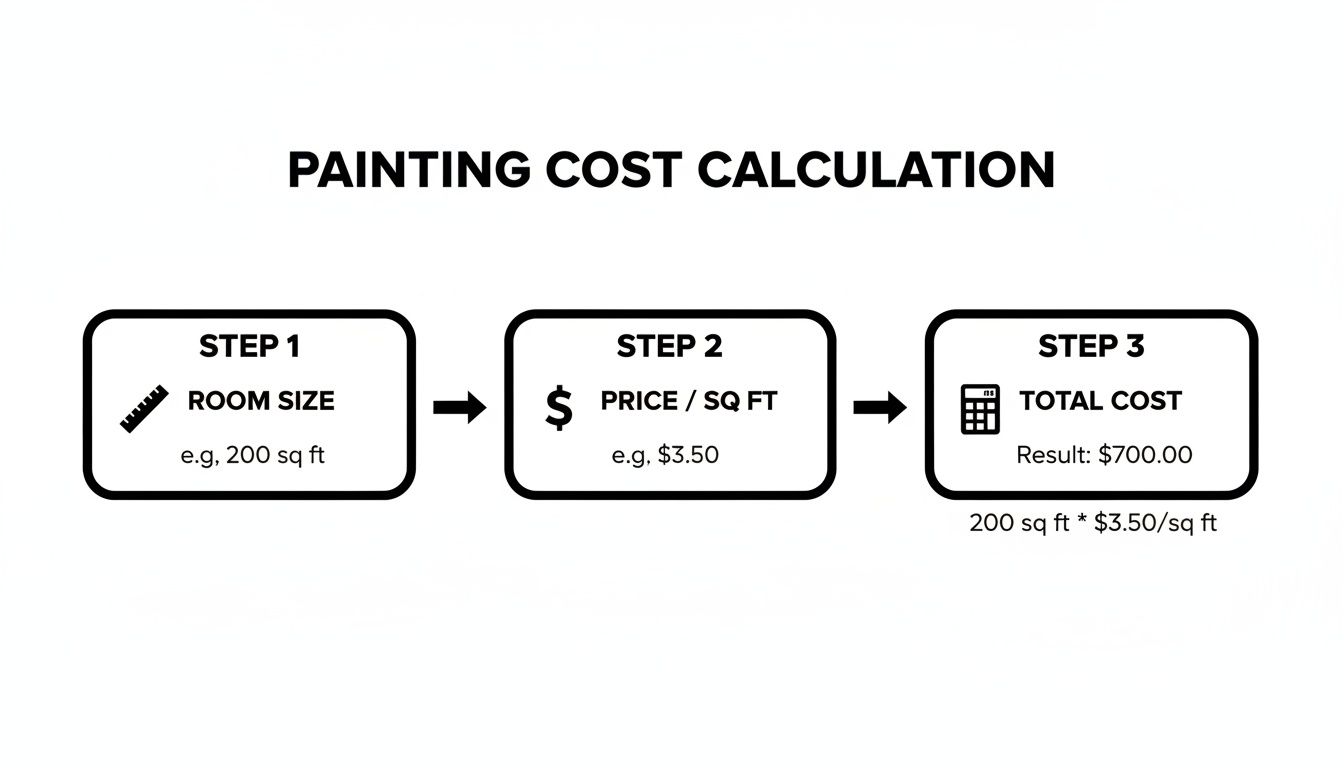
As you can see, getting the room size right is the critical first step. From there, it's a matter of applying a cost-per-foot rate to get to the total.
Why do we measure everything separately? Because the work is completely different. Painting trim is meticulous, slow work that costs more per linear foot. Ceilings, especially vaulted or high ones, take more time and specialized equipment, which also affects the labor cost.
Putting It All Together: A Real-World Example
Let's walk through a more complex space, like a master bedroom. Imagine a 16x20 foot room with 9-foot ceilings. It also has a big bay window, a door to a walk-in closet, and another leading to an ensuite bathroom.
1. Calculate the Wall Area:
- Perimeter: 16 + 20 + 16 + 20 = 72 linear feet
- Total Wall Area: 72 ft x 9 ft = 648 square feet
- Subtract Openings: Two doors (2 x 21 sq ft = 42 sq ft) plus a large bay window (we'll estimate 40 sq ft) = 82 square feet.
- Final Paintable Wall Area: 648 - 82 = 566 square feet
2. Calculate the Ceiling Area:
- Ceiling Area: 16 ft x 20 ft = 320 square feet
3. Tally the Trim Footage:
- Baseboards: Roughly 72 linear feet, minus the width of the two doors.
- Door Casings: Each door has about 17 linear feet of trim.
- Window Casing: That big bay window could easily have 30+ linear feet of trim to paint.
When you break a project down like this, you're armed with specific numbers. This allows you to have a much more productive, clear conversation with a contractor about costs.
If your project is complex or you'd just rather have a professional handle it, you can explore our full range of expert interior services to see how we can bring your vision to life. Having these measurements ready when you call will make that first consultation incredibly smooth.
What Really Drives Your Painting Budget?

Once you have your room measurements, you’ve got a good starting point. But the truth is, the final quote you'll get from a pro is shaped by so much more than just square footage. A few key variables can dramatically swing your total budget, turning a seemingly simple job into a much bigger investment.
Getting a handle on these cost drivers is the key to creating a realistic estimate. These are the details that separate a quick, budget-friendly refresh from a more serious overhaul of your home’s look and feel.
It All Starts With the Paint
Not all paint is created equal, and your choice here impacts both your material bill and the labor it takes to apply it. I always tell clients to think of paint on a "good, better, best" scale. While grabbing the cheapest gallon is tempting, premium paints often deliver value that saves you money in the long run.
- Builder-Grade Paint: This is your basic, budget-friendly option. It covers, but it lacks the durability and washability of better paints. It's really only suitable for low-traffic areas you won't need to scrub.
- Mid-Grade Paint: For most homeowners, this is the sweet spot. It's a great balance of cost and performance, offering better durability and cleaning ease than its cheaper counterparts.
- Premium Paint: This is the top-shelf stuff. You get superior coverage, exceptional durability, and formulas that often combine paint and primer. The upfront cost might be $50-$80 per gallon (versus $20-$30 for budget paint), but it can save a ton of labor by covering in fewer coats.
Think about it: since labor makes up 70-85% of a typical painting bill, spending more on a high-quality paint that shaves hours off the job is often the smarter financial move.
The Prep Work Is Everything
The condition of your walls is hands down the biggest wildcard in any painting estimate. A painter's dream is to walk into a room with smooth, clean walls ready for color. That rarely happens. The amount of prep work needed translates directly into hours on the clock for the crew.
A flawless final coat is only possible with meticulous preparation. What you're really paying for isn't just the painting; it's the painstaking work that happens before a brush even touches the wall. This prep phase ensures the paint adheres properly and looks perfect for years to come.
Extensive prep work involves a whole range of tasks, and each one adds time and money to the project.
Common Prep Tasks and Their Impact
- Minor Patching: Filling a few nail holes and scuffs is standard procedure and is usually baked into a basic quote.
- Significant Drywall Repair: We're talking larger holes, stress cracks from the house settling, or deep dings. These require more involved work—taping, mudding, and sanding multiple coats.
- Sanding and Smoothing: If your walls have a rough texture or the remnants of a bad paint job, they might need to be sanded down completely for a smooth, professional finish.
- Cleaning: Kitchen and bathroom walls are notorious for grease and grime buildup that has to be thoroughly scrubbed off before any primer goes on.
- Water Damage Repair: Stains from old leaks need special treatment. For a deep dive, our guide on how to fix water-damaged drywall explains just how involved this can be: https://garnercandm.com/blogs/news/how-to-fix-water-damaged-drywall
A room needing just a few nail holes filled will always cost less than an identical room with peeling paint and cracked drywall. It's that simple.
Decoding Professional Labor Rates
Labor is the biggest piece of the puzzle. A professional painter’s hourly rate can run anywhere from $40 to over $100, and that price is a blend of their expertise, business costs, and the job's specific demands.
What's Included in a Painter's Rate?
- Geographic Location: Costs vary wildly by region. A painter in a major city has higher overhead and will charge more than a painter in a small town.
- Experience and Reputation: A top-tier crew with a great reputation and a portfolio of perfect jobs commands a higher rate. You're paying for their efficiency, skill, and peace of mind.
- Job Complexity: How tricky is the work? Soaring ceilings that need scaffolding, detailed trim and crown molding, or rooms full of furniture to work around all add time and require more skill, bumping up the labor cost.
When you're plugging numbers into an interior painting cost estimator, always keep these three core components in mind: the quality of the materials, the time needed for prep, and the cost of skilled labor.
Budgeting for a Whole-Home Painting Project
When you move from painting a single room to tackling your entire home, the budgeting process shifts gears. It's not just about multiplying the cost of one room by ten. You're now dealing with a much larger scope, which brings both potential savings from economies of scale and the risk of uncovering hidden problems, especially in older houses.
Thinking about the project in terms of your home's total square footage is a great way to get a ballpark figure. Of course, the cost to paint a home's interior can swing wildly depending on where you live, the condition of your walls, and the level of detail involved.
Nationally, a full interior paint job for a 1,000-square-foot home typically lands somewhere between $2,000 and $6,000. Bump that up to a 1,200-square-foot house, and the range might look more like $2,400 to $7,200. These numbers cover everything from a straightforward repaint to a high-end project with tons of prep work. Just remember, a huge chunk of that cost—often 70-80%—is for labor and prep, not just the paint itself. For a deeper dive into the numbers, check out the full report on interior painting expenses.
Scaling Your Estimate for Different Home Sizes
One common mistake is assuming the cost per square foot stays the same no matter the size of the job. It often doesn't. While a bigger project definitely means more paint and more hours, contractors can work much more efficiently when they can move from room to room without having to pack up and set up elsewhere. This can sometimes lead to a slightly lower cost per square foot compared to a one-off room project.
Here’s a rough guide to what you might expect for different home sizes, keeping in mind these are just starting points:
- 1,500 sq ft Home: A complete interior repaint will likely be in the $3,000 to $9,000 range.
- 2,000 sq ft Home: You’re probably looking at a budget between $4,000 and $12,000.
- 3,000+ sq ft Home: For larger homes, costs can easily climb past $15,000, especially if you have high ceilings, lots of detailed trim, or built-in shelving.
These estimates generally cover your walls, ceilings, and standard trim. Things like vaulted ceilings, intricate crown molding, or painting a bunch of French doors will nudge your final price toward the higher end of these brackets.
The Impact of Unforeseen Issues
Older homes are notorious for hiding little surprises that can throw a budget off track. What seems like a minor surface crack could be a symptom of foundation settling that needs more than a dab of spackle. That's why I always recommend building a contingency fund of 10-15% into your budget for a whole-home project.
Here are a few common curveballs that can drive up costs:
- Significant Drywall Damage: Widespread cracks, old water stains, or terrible patch jobs from previous owners can add hundreds, sometimes thousands, to the prep bill.
- Failing Paint: If old paint is peeling and flaking off, it all has to be scraped and sanded down. This is a messy, labor-intensive job.
- Outdated Wall & Ceiling Textures: Removing popcorn ceilings or smoothing out heavily textured "slap brush" walls is a huge undertaking that adds serious time and money to the project.
Pro Tip: When you get quotes, walk through the house with each contractor. Point out every crack, stain, and imperfection you see. Ask them to list the cost for these specific repairs as separate line items on the estimate. This gives you a crystal-clear picture of where your money is going.
To show how all these components add up, here’s a sample estimate for a typical 1,500-square-foot home.
Sample Whole-Home Painting Estimate Breakdown
| Cost Component | Description | Estimated Cost |
|---|---|---|
| Labor & Prep | Covering floors, taping, filling holes, sanding, priming, and cleanup. | $4,500 |
| Wall Painting | Two coats of mid-grade paint on approx. 3,000 sq ft of wall surface. | $1,800 |
| Ceiling Painting | One coat of flat white ceiling paint for 1,500 sq ft. | $750 |
| Trim & Doors | Painting all baseboards, window/door casings, and 10 interior doors. | $1,200 |
| Paint & Materials | Includes all paint, primer, tape, plastic, caulk, and supplies. | $950 |
| Contingency (10%) | Set aside for unexpected drywall repairs or additional prep. | $920 |
| Total Estimated Cost | $10,120 |
This breakdown gives you a much clearer idea of the total investment compared to a simple per-square-foot guess.
Case Study: A 1,200 Square Foot Home
Let's ground this with a real-world example. Picture a 1,200-square-foot ranch-style home: three bedrooms, two baths, a living room, and a kitchen. The owners want a full refresh—walls, ceilings, trim, and doors.
Here’s one way a professional quote might break down:
- Walls: Roughly 2,500 sq ft of wall surface at $2/sq ft = $5,000
- Ceilings: 1,200 sq ft of flat ceilings at $1.50/sq ft = $1,800
- Trim & Doors: About 400 linear feet of baseboards and casings, plus 8 doors, at around $3/linear ft = $1,200
- Initial Project Quote: $8,000
But wait. Once the crew starts prepping, they find a few long settlement cracks and some bubbling paint from an old leak in one of the bathrooms. The extra repair work adds $600 to the bill, bringing the final cost to $8,600. This is exactly why a contingency fund is so important.
Planning a whole-home painting project is a major step in any renovation. To keep all your tasks organized, be sure to use our comprehensive home renovation checklist.
Smart Strategies to Lower Your Painting Costs

A fresh coat of paint can completely transform your home, but the price tag doesn't have to be intimidating. With some smart planning, you can get that beautiful, lasting finish without breaking the bank.
The secret is knowing where the money really goes. Since professional labor typically makes up 75-85% of the final invoice, the biggest way to save is by cutting down the time a painting crew spends in your home. This is where a little sweat equity goes a long, long way.
Handle the Simple Prep Work Yourself
A painter can't just walk in and start rolling. There’s a surprising amount of prep work that happens first, and much of it is tedious but simple stuff you can easily knock out yourself over a weekend. Doing so can shave hours off the professional labor bill.
Before the pros arrive, consider tackling these tasks:
- Move All Furniture: Clearing the room is a huge help. Shifting everything to the center of the room and covering it is good; moving it out of the room entirely is even better.
- Remove Wall Hangings and Hardware: Take down pictures, mirrors, curtains, and outlet covers. Pop all the screws and hardware into labeled plastic bags to make reassembly a snap.
- Clean the Walls: You'd be surprised how much grime builds up on walls, especially in kitchens. A quick wash with a sponge and a mild detergent solution gives the new paint a clean surface to stick to.
When you do this, you're essentially handing the painters a clean, ready-to-go canvas. They can jump right into the skilled work—taping, patching, and painting—which directly translates to fewer hours on your bill.
Taking on the basic prep work yourself is one of the most effective ways to lower your final bill. Painters bill for their time, and every hour you save them is money that stays in your pocket.
Be Smart About Timing and Paint Choices
Beyond the prep, a couple of other key decisions can have a big impact on your budget. When you schedule the job and what paint you choose are powerful cost-control levers.
First, think about timing. Late spring and summer are prime time for home improvement, and painters are in high demand. If you can wait for the off-season—late fall or winter—you might find contractors are more willing to offer a competitive price to keep their crews busy.
Next, let's talk about paint. It might sound backward, but spending a little more on a higher-quality can of paint often saves you money in the long run.
Why Premium Paint Can Save You Money
| Feature of Premium Paint | How It Lowers Your Cost |
|---|---|
| Better Coverage | A good paint often requires fewer coats. That means less time for the painter to get a solid, even color. |
| Built-In Primer | Many premium paints are a "paint-and-primer-in-one," which can eliminate a whole step, saving on materials and labor. |
| Enhanced Durability | Higher-quality finishes are more scrubbable and resist scuffs, meaning fewer touch-ups and more years before you have to repaint. |
This doesn't mean you need the most expensive paint on every surface. It's all about choosing the right tool for the job. Use a durable, premium semi-gloss on high-traffic areas like trim and doors, but you can probably get away with a quality mid-grade eggshell or matte finish for the walls in a low-traffic guest bedroom. This balanced approach is a great way to manage costs when using an interior painting cost estimator to build your budget.
Your Painting Cost Questions Answered
Once you start thinking about painting, the big-picture questions quickly turn into nitty-gritty details. It’s one thing to get a rough idea of the cost, but it’s another thing entirely to understand what goes into that final number.
Let’s dig into some of the most common questions homeowners have. Getting these sorted out now will save you a ton of headaches and potential budget surprises down the road.
How Much Paint Do I Actually Need for a Room?
The old rule of thumb is that one gallon of paint covers about 350 to 400 square feet of a smooth, already-primed wall. It's a decent starting point.
So, for a standard 12x12 foot room with 8-foot ceilings, you'd calculate the wall area like this: (12+12+12+12) x 8 = 384 square feet. It seems like one gallon is the magic number, right? Not so fast.
A single coat almost never cuts it. For that rich, durable color you see in magazines, you should always plan on applying two full coats. Just like that, your paint needs have doubled.
And a few other things can throw your calculations off:
- Wall Texture: Got rough plaster or heavily textured drywall? Those surfaces act like a sponge and will drink up more paint than a perfectly smooth wall.
- Big Color Swings: Painting a light, airy beige over a dark navy blue wall is a battle. You’ll definitely need a good primer and might even need a third coat of your new color to stop the old one from peeking through.
- Paint Quality: This is a big one. High-quality paints have better pigments and binders, giving you superior coverage. You might squeeze more square footage out of a premium gallon, whereas cheaper paints are often thinner and demand extra coats.
My advice? Always buy a little more paint than you think you need. Having an extra quart tucked away for future touch-ups is a lifesaver when the first scuff mark appears.
Is It Cheaper to Hire a Painter or Do It Myself?
This really boils down to a classic trade-off: your money versus your time.
The biggest savings with any DIY project comes from cutting out labor, and painting is no exception. Labor typically makes up a whopping 70% to 85% of a professional painter's quote. If you do it yourself, your only real costs are the materials—paint, primer, brushes, rollers, tape, and drop cloths.
But what you save in cash, you pay for in time, sweat, and the risk of a not-so-great finish. Professional painters are fast because they've done it a thousand times. They have the right gear, the muscle memory for cutting in a perfectly straight line, and the know-how to prep surfaces so the paint job actually lasts.
Think about the project itself. Painting a small guest bedroom with walls in good shape? That’s a perfect weekend DIY project that can save you a bundle. But if you’re tackling a whole house, a room with soaring vaulted ceilings, or you just can't stand the sight of a crooked line, hiring a pro is an investment in your sanity and the final result.
What Is the Cost Difference Between Painting Trim, Ceilings, and Walls?
Not all surfaces are created equal, and painters price them accordingly. Each part of a room is a different beast, requiring a different amount of time and skill.
- Walls: This is your baseline. Walls are generally the most straightforward part of the job and are priced per square foot. They make up the most area but are the least labor-intensive to paint.
- Ceilings: Suddenly, you're fighting gravity. Painting ceilings is physically tough work. It involves extension poles and a specific technique to avoid drips and ugly roller marks. If you have high or vaulted ceilings that require scaffolding, the labor cost and the per-square-foot rate will jump up even more.
- Trim: This is where the real time and money go. Trim—we're talking baseboards, door frames, window sills—is meticulous, detailed work. It requires a steady hand, a ton of taping, and a lot of patience. Because it’s so slow, painters price trim per linear foot, and it can add a surprising amount to the final bill, especially in older homes with lots of custom molding.
When you get a quote, always ask for it to be itemized. That way, you'll see exactly what you're paying for each part of the job.
How Does Paint Finish Affect the Final Cost?
You'd think the price difference between a can of flat paint and a can of semi-gloss would be minor, and you'd be right. The real cost impact of your chosen paint sheen isn't in the material, it's in the labor.
Here's why: the glossier the paint, the more it highlights every single imperfection on your wall.
Satin, semi-gloss, and high-gloss finishes reflect light, which means they act like a spotlight on any tiny bump, old nail pop, or uneven drywall patch. To make a glossy finish look good, a painter has to spend a huge amount of time on prep—patching, sanding, and smoothing the wall until it's nearly perfect.
On the flip side, flat or matte finishes are miracle workers for hiding flaws. They absorb light, so minor imperfections on the wall practically disappear. This means the prep work doesn't have to be as intense, which saves a lot of time and, therefore, money. So while the gallon of semi-gloss may only be a few dollars more, the hours of prep work required can make the total project cost significantly higher.
Ready to turn your vision into reality with a flawless, professional finish? The team at Garner Construction & Maintenance is here to handle every detail, from meticulous prep work to the final, perfect coat. Visit us online to get a transparent and reliable estimate for your project.