

So, you’re thinking about remodeling your kitchen. It’s one of the most exciting home projects you can tackle, but it’s also one where the costs can quickly spiral if you’re not prepared.
Let's get right to it: the average cost of a kitchen remodel usually lands somewhere between $15,000 for a minor refresh and can easily soar past $150,000 for a high-end, custom gut job. Most people, though, find themselves in the middle ground, spending between $25,000 and $50,000 for a solid, mid-range renovation.
Your Quick Guide to Kitchen Remodel Costs
Trying to pin down a budget for a kitchen remodel can feel a bit like guesswork. The final number depends on so many things—the size of your space, the materials you fall in love with, and even what part of the country you live in. These initial figures are just a starting point to help you get your bearings.
Think of this guide as your financial roadmap. We'll break down the costs into clear, manageable tiers. Whether you're dreaming of a simple cosmetic update or a complete floor-to-ceiling overhaul, you'll walk away with a much clearer picture of what your project might actually cost.
Understanding the Three Tiers of Remodeling
To keep things simple, contractors and designers usually talk about kitchen projects in three distinct categories. Figuring out which one fits your vision is the first step to building a realistic budget.
- Minor Kitchen Remodel: This is your budget-friendly facelift. You're keeping the kitchen's current layout and bones but giving everything a fresh new look.
- Mid-Range Kitchen Remodel: This is the sweet spot for most homeowners. It goes beyond just cosmetics and involves replacing major components like all the cabinets and appliances, and maybe even adding an island.
- Major or High-End Kitchen Remodel: This is the full works—a complete tear-out. We're talking about moving walls, reconfiguring plumbing and electrical, and bringing in high-end, custom everything.
It’s no surprise that the mid-range remodel is consistently one of the most popular home improvement projects. Recent industry data puts a minor kitchen remodel at an average of $28,458, while a more involved mid-range project can hit $82,793. In terms of what you get back, you can generally expect to recoup around 59% of the cost when you sell your home, making it a pretty solid investment. If you want to dive deeper into the numbers, you can discover more insights about kitchen remodeling costs on HomeLight.
To give you a better sense of where your project might land, let’s break down what each tier typically involves.
Kitchen Remodel Cost Tiers at a Glance
This table gives you a quick snapshot of the three main project tiers. Use it to see which category best matches the scope—and budget—you have in mind.
| Remodel Tier | Typical Scope of Work | Average Cost Range | Estimated ROI |
|---|---|---|---|
| Minor Refresh | Cabinet refacing, new hardware, new countertops, fresh paint, updated sink and faucet, new flooring. | $15,000 - $30,000 | 70% - 80% |
| Mid-Range | All new semi-custom cabinets, new appliances, new countertops, new lighting, possible island addition. | $30,000 - $85,000 | 60% - 70% |
| Major Gut Remodel | Full gut, new layout, custom cabinetry, high-end appliances, structural changes, upgraded electrical and plumbing. | $85,000 - $150,000+ | 50% - 60% |
Seeing it all laid out like this really helps clarify how a few key decisions can shift your project from one category to the next. The jump from refacing cabinets to replacing them entirely is often what pushes a project from a minor refresh into a mid-range remodel.
Where Your Remodeling Budget Really Goes
It’s one thing to know the average cost of a kitchen remodel, but it’s another to understand where every single dollar is going. That knowledge is what separates a stressful, budget-busting project from a smart, realistic one.
Think of your budget less as a single, intimidating number and more like a pie chart. Each slice—from the cabinets that set the tone to the skilled labor that brings it all together—represents a specific cost. Let's break down that pie so you can see exactly where the money goes and where you have the most control.
This chart gives a great visual of how costs scale across different project scopes.
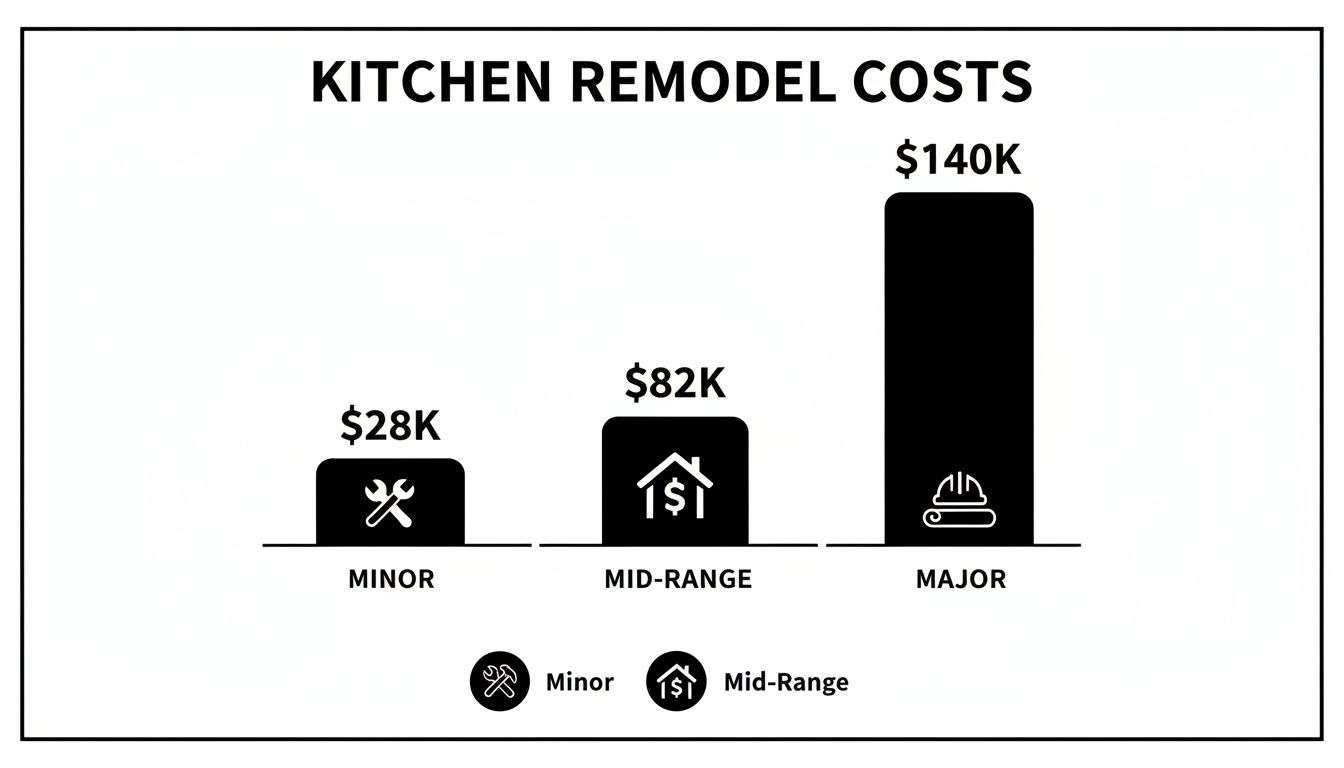
As you can see, the jump from a minor refresh to a full-gut remodel is huge. The difference isn't just in the price tags of the materials; it's also about the sheer amount of complex labor involved.
The Major Budget Categories Unpacked
When a contractor hands you a quote, it won't be just one number. It will be itemized into several key categories. While the exact percentages might shift a bit depending on your specific plans, they almost always follow a predictable pattern.
For a typical mid-range kitchen remodel, here’s how your funds are likely to be allocated:
- Cabinetry and Hardware (30-35%): No surprise here. This is almost always the biggest ticket item in any kitchen project.
- Labor and Installation (20-30%): The skilled work of installers, plumbers, electricians, and painters is a massive part of the cost.
- Appliances (10-15%): Your choices here can cause huge swings in the budget. Will it be standard models or pro-grade statement pieces?
- Countertops (10-15%): The material you choose—from affordable laminate to luxurious natural stone—is the main driver of this cost.
- Flooring (5-7%): It may be a smaller slice of the pie, but your flooring is a foundational element for both design and budget.
- Everything Else (10-15%): This is the catch-all category for lighting, plumbing fixtures, your backsplash, paint, and permits.
One of the most common mistakes homeowners make is underestimating the cost of labor. It’s not just one person installing cabinets. It’s the careful coordination of a whole team: demolition crews, electricians, plumbers, drywallers, and painters. Each one is essential to getting the job done right.
Why Do Cabinets Cost So Much?
Cabinets are the backbone of your kitchen. They do the heavy lifting for storage and define the room's entire look, which is why they’re the biggest investment you'll make. They consistently represent the single largest expense, with U.S. demand projected to hit $20.9 billion by 2026.
Even for a modest remodel, cabinets can easily eat up nearly a third of your funds. Costs can range from $100-$300 per linear foot for basic stock options to over $1,200 for high-end, custom-built pieces. You can dig deeper into cabinetry cost trends and their market impact to get a better sense of these figures.
Don't Forget the Hidden Costs
Beyond the shiny new appliances and countertops, your budget needs to cover the things you can't see—the stuff that makes a kitchen safe and functional.
- Plumbing and Electrical: Moving a sink, adding an island with outlets, or upgrading old wiring to meet current building codes requires licensed pros and can easily add thousands to your bill.
- Permits and Fees: Depending on where you live and what you’re changing, you'll need to pull permits. These can run anywhere from a few hundred to several thousand dollars.
- The "Surprise" Factor: You never truly know what’s behind the walls until demolition begins. Old leaks, hidden mold, or pest damage can bring a project to a screeching halt and add unexpected repair costs. For instance, you might suddenly have to learn how to fix water-damaged drywall before the new cabinets can even be ordered.
Having this financial roadmap from the start is the best way to prevent sticker shock later. It helps you decide where to splurge and where to save, turning you into a more informed partner for your contractor. Ultimately, it’s about creating a kitchen that fits your vision and your wallet.
How Your Kitchen's Size and Location Affect the Price Tag
Those national averages you see for kitchen remodels? They're a great starting point, but they’re just that—a start. The real cost of your project is going to be shaped by two very personal factors: where you live and how big your kitchen is. Think of the national average as the manufacturer's suggested retail price; your local reality is the number on the final sticker.
Just like a gallon of milk costs more in Manhattan than it does in rural Ohio, the same goes for construction. Labor rates, material delivery, and even the cost of permits can swing wildly from one zip code to the next. Getting a handle on these local differences is the first step in turning a vague estimate into a budget you can actually work with.
The "Big City" Price Bump
Ever wonder why the exact same remodel costs a fortune in a dense urban area but is far more reasonable an hour away in the suburbs? It’s not your imagination. It all comes down to basic economics and logistics.
- Higher Labor Costs: Good, skilled tradespeople are always in demand, but in major metro areas, that demand is off the charts. This drives their hourly rates way up.
- Logistical Headaches: Think about it. Navigating city traffic, finding a place to park a work truck for eight hours, and dealing with notoriously strict building codes all add time—and time is money.
- Material Delivery Hurdles: It's a lot harder to get a pallet of tile or a massive countertop slab delivered to a 10th-floor apartment than it is to just drop it in a suburban driveway.
All these factors add up. In fact, you can expect to pay a 20-50% premium over the national average for a project in a major city. Labor alone often eats up 20-30% of the entire budget. This is also why it's crucial to have a safety net; with roughly 40% of projects going over budget, a contingency fund of 15-25% isn't just a good idea, it's essential. You can learn more about how kitchen remodel costs escalate to get a clearer picture of these variables.
A Smarter Way to Estimate: Cost Per Square Foot
While every kitchen is different, contractors often use a cost-per-square-foot range to bring some sanity to the estimating process. It’s a simple, practical metric that helps standardize the cost across different layouts and sizes.
This approach lets you scale those big national numbers down to a figure that actually fits your room. The range for kitchens is pretty wide, but it gives you a much more personalized starting point.
A solid rule of thumb is to budget between $75 and $250 per square foot for a kitchen remodel. A simple refresh will land you on the lower end of that scale, while a full gut job with all the high-end bells and whistles will push you toward that $250 mark.
Let's See It in Action: Sample Budgets
So, how do these numbers actually play out in the real world? Let's apply this logic to a few common kitchen sizes, assuming a mid-range remodel.
- The Small Kitchen (Under 100 sq. ft.): Perfect for a city condo or a classic galley kitchen. Here, you're likely looking at a total cost between $10,000 and $20,000. The compact footprint simply requires less material for everything from cabinets to countertops.
- The Medium Kitchen (150-200 sq. ft.): This is the sweet spot for most suburban homes. A mid-range project of this size usually lands somewhere between $30,000 and $55,000. This budget can typically accommodate a nice island and a full suite of new appliances.
- The Large Kitchen (Over 250 sq. ft.): For a big, open-concept space, the sky's the limit, but a good starting estimate is anywhere from $60,000 to over $100,000. More square footage means more of everything—more cabinetry, more countertop, and more labor to install it all.
As you can see, the budget expands quickly with every extra foot of space. By combining the cost-per-square-foot method with a realistic understanding of your local market, you can move from a ballpark guess to a truly reliable budget for the kitchen you've been dreaming of.
Proven Ways to Save on Your Kitchen Remodel
Let's be honest: a kitchen remodel can feel like a financial black hole. It's easy to get swept up in visions of high-end everything and watch the budget spiral. But getting a stunning, functional kitchen doesn't mean you have to drain your savings. The real secret is being strategic.
This isn't about cheaping out or cutting corners that you'll regret later. It's about smart planning—investing your dollars where they deliver the most impact and making savvy choices on everything else. From your kitchen's layout to the hardware on your cabinets, every decision is a chance to save.

Keep Your Existing Footprint
Want to know the single most effective way to keep your remodel costs in check? Don't move anything. Seriously. The moment you decide to relocate the sink, move the stove across the room, or knock down a wall, your budget explodes.
Why? Because you're no longer just dealing with cosmetic updates. Changing the layout introduces a whole new level of complexity and cost.
- Plumbing: Moving a sink or dishwasher means tearing into walls to reroute supply and drain lines. That's a job for a licensed plumber, and it can easily add hundreds, if not thousands, to the final bill.
- Electrical: Shifting appliances like a refrigerator or oven, or adding an island with power, requires complex rewiring. This is especially tricky and expensive in older homes with outdated electrical systems.
- Structural Changes: Taking down walls—even ones that aren't load-bearing—is a cascade of costs. It involves demolition, reframing, and then extensive drywall and finishing work to make it all look seamless.
By working within your kitchen's current layout, you sidestep all these major expenses. This frees up your budget for the fun stuff you'll actually see and use every day, like gorgeous countertops and new appliances.
Get Creative with Cabinets and Countertops
Cabinets are almost always the biggest line item on a kitchen remodel invoice, so any savings here will have a massive impact on your total spend. But that doesn't mean you're stuck with what you have. If the cabinet boxes themselves are still solid, you have some fantastic, cost-effective options.
Cabinet Refacing: This is a brilliant compromise. You keep the cabinet boxes but get all-new doors and drawer fronts, and the exterior of the boxes is covered with a matching veneer. You get the look of a brand-new kitchen for a fraction of the cost and in much less time.
Paint Them: Never underestimate the power of a professional paint job. Done right, a fresh coat of high-quality paint can completely modernize dated wood cabinets. The finish is durable, looks fantastic, and can save you up to 70% compared to buying all-new custom cabinets.
Smart material selection is your best friend when budgeting. You can create a high-end look by mixing materials. Splurge on a beautiful quartz or granite for your high-visibility island, then choose a more affordable but complementary material, like butcher block or a high-quality laminate, for the perimeter counters.
This "high-low" approach gives you a show-stopping focal point without the premium price tag of outfitting the entire kitchen in the same expensive material. This is just one of many ideas we cover in our complete guide to a budget-friendly kitchen remodel.
Make Smart Material and Labor Choices
Beyond the big-ticket items, plenty of other opportunities exist to trim the budget without sacrificing style. It’s all about finding that sweet spot between cost, aesthetics, and long-term durability.
- Shop for Remnants: If you only need a small piece of stone for a coffee bar or a compact island, ask your countertop fabricator about their remnants. These are the leftover pieces from bigger jobs, and they're sold at a serious discount.
- Handle Some Demolition Yourself: Feeling handy? You can save a decent chunk on labor by tackling some of the light demolition. Things like removing old cabinets, tearing out a tile backsplash, or pulling up old vinyl flooring are often manageable DIY tasks.
- Choose Look-Alike Materials: Technology has come a long way. Luxury vinyl tile (LVT) can convincingly mimic the look of real hardwood or stone for a much lower price and simpler installation. The same goes for countertops, where modern laminates offer incredibly stylish options.
- Buy Appliances in a Bundle: Retailers love to bundle. You can often score a significant discount by purchasing your fridge, oven, and dishwasher from the same brand at the same time. Keep an eye out for holiday sales events to stack those savings even higher.
By weaving these strategies into your plan, you can thoughtfully bring down the total cost of your project. It’s proof that a beautiful, highly functional kitchen is well within reach, no matter the budget.
How Long Will My Kitchen Remodel Actually Take?
Getting a handle on the budget is a huge first step, but the timeline is the other half of the equation. Let’s be honest, living without a functioning kitchen is tough. Knowing what to expect and for how long makes the whole process so much more manageable.
A kitchen remodel isn’t a weekend project; it's a carefully orchestrated sequence of events. Think of it less like a sprint and more like a multi-stage race where each leg of the journey depends on the one before it. A simple cosmetic refresh might be a quick 5k, while a full gut renovation is a marathon that requires serious planning and endurance.

The Four Main Phases of a Renovation
Every project has its own quirks, but almost all kitchen remodels follow the same four-phase path. A minor refresh might breeze through these in a few weeks, but a major overhaul can easily stretch across several months.
Phase 1: Planning and Design (2-8 Weeks)
This is where all the big decisions happen. You’ll be working with a designer or contractor to finalize your layout, pick out everything from cabinets to countertops, and interview potential builders to get detailed quotes. It's also when you'll apply for building permits, a step that can sometimes have a mind of its own.
Phase 2: Ordering and Waiting (4-12 Weeks)
This phase is the quiet before the storm and often the longest part of the process. Custom and even semi-custom cabinets can have surprisingly long lead times, sometimes taking 8 weeks or more to arrive. Appliances, specialty tile, and custom light fixtures also need to be ordered well ahead of time to prevent everything from grinding to a halt later.
Phase 3: Demolition and Construction (3-8 Weeks)
Here we go! This is when your old kitchen gets torn out and the real work begins. Your contractor will handle the "rough-in" for new plumbing and electrical, followed by drywall, flooring, and finally, installing your new cabinets and countertops. It's dusty, it's loud, but it's where the vision starts to take shape.
Phase 4: Finishing Touches (1-3 Weeks)
You're in the home stretch! This final phase is all about the details that make the kitchen shine. The backsplash goes in, walls get painted, and all the appliances, lights, and plumbing fixtures are connected. The project wraps up with a final inspection and a walkthrough with your contractor to create a "punch list" of any small fixes needed.
A word of advice from the pros: the timeline isn't just the time hammers are swinging. The waiting period for materials is often the longest, most frustrating part. Never, ever let a contractor start demolition before your cabinets and other critical items are physically on site.
Planning for the Inevitable Hiccups
Even the best-laid plans can go sideways. That's why building a buffer into both your budget and your timeline isn't just a good idea—it's essential.
Here are a few common curveballs to anticipate:
- Permit Purgatory: Your local building department might be swamped, pushing back your start date.
- Surprises in the Walls: Once drywall comes down, you might find anything from old, faulty wiring and hidden leaks to pest damage that has to be fixed.
- Supply Chain Snags: The exact tile or faucet you fell in love with could suddenly be backordered for weeks, pausing progress.
Understanding this flow from the very beginning helps you set realistic expectations. It makes for clearer communication with your contractor and drastically reduces the stress of the unknown, ensuring your path to a new kitchen is as smooth as your future countertops.
Getting Accurate Quotes from Contractors
Picking the right contractor is hands down the most critical decision you'll make for your kitchen remodel. This person isn't just a vendor; they're your partner in a complex, expensive project. The right one will make the process smooth and bring your vision to life. The wrong one can turn your dream kitchen into a disaster zone of delays and surprise costs.
The first step in finding that perfect partner is navigating the quoting process. To get a true picture of the average cost of a kitchen remodel in your neck of the woods, you need to gather several bids. This isn't just about price shopping. It’s about understanding what your specific project should actually cost.
Why You Need at Least Three Quotes
Let’s be clear: getting a minimum of three detailed quotes from different, well-regarded contractors is non-negotiable. Think of it like a medical second opinion, but for your home. Each pro brings a slightly different perspective, and laying their proposals side-by-side tells you a lot. One quote is just a number in the dark. Three quotes establish a realistic market value.
This simple step is your best defense against wildly inflated bids or, just as dangerous, suspiciously low-ball offers. A price that seems too good to be true almost always is—it often means cut corners, cheap materials, or uninsured labor. Comparing quotes lets you look beyond the final number to see differences in materials, timelines, and overall professionalism. A huge gap between bids is an immediate red flag.
What a Professional Quote Includes
A real, professional quote is so much more than a single number on an invoice. It should be a transparent, detailed document that breaks down every single piece of the job. This is the blueprint for your project and your best tool for making an apples-to-apples comparison.
Any comprehensive proposal worth its salt will include:
- A Line-Item Breakdown: The quote must itemize the costs for everything—demolition, cabinets, countertops, plumbing, electrical work, flooring, and paint. No lump sums.
- Specific Material Allowances: It should either name the exact brands and models of materials or provide a clear budget (an "allowance") for items like appliances or tile (e.g., "$3,000 for the appliance package").
- A Clear Payment Schedule: This shows you exactly when payments are due, typically tied to project milestones like "after demolition is complete" or "upon cabinet installation."
- Project Timeline: A pro will give you an estimated start date and a projected completion date. It's an estimate, but it shows they have a plan.
- Proof of Licensing and Insurance: Their contractor's license number and certificates for liability and worker's comp insurance are essential. Don't just take their word for it; ask for the documents.
Vague estimates are a massive warning sign. If a contractor just gives you a single number with no details, they're either amateur or hiding something. A true partner will happily walk you through every line item so you know exactly where every dollar is going.
Knowing what to ask is your superpower in this process. For a complete checklist, check out our guide on the essential questions to ask your general contractor before you even think about signing a contract. Being prepared helps you spot red flags, like a contractor who pressures you for a quick decision or asks for a huge cash deposit upfront. By demanding clarity from day one, you build the trust needed for a successful remodel.
A Few Final Questions About Your Kitchen Remodel
Alright, we've talked through the numbers, the timelines, and how to save a buck or two. But even after all that, a few big questions usually linger. I get it. This is your chance to get those last nagging doubts sorted out before you commit.
Think of this as the final huddle before the game begins. Let's make sure you're feeling 100% confident and ready for what's ahead.
What’s the Smartest Way to Pay for This?
When it comes to funding your remodel, you've got a few solid paths to choose from, and each has its own pros and cons.
A lot of people go for a Home Equity Line of Credit (HELOC) or a standard home equity loan. These are popular for a reason—they use your house as collateral, which usually means you'll get a much better interest rate than you would with an unsecured loan.
Another common strategy is a cash-out refinance. You essentially get a new, bigger mortgage, pay off the old one, and pocket the difference for your renovation. For smaller projects, a personal loan can work, or if you're disciplined, a credit card with a 0% introductory APR might be just the ticket. My best advice? Chat with a financial advisor to figure out which option makes the most sense for your specific situation.
Will I Actually Get My Money Back When I Sell?
Yes, absolutely. A smart kitchen remodel is one of the best investments you can make in your home. But it's all about understanding the return on investment (ROI), which really depends on how big you go.
Here's the inside scoop: A minor to mid-range kitchen remodel almost always gives you the best bang for your buck. It’s not uncommon for homeowners to see a return of 60% or more of what they spent when they sell. High-end, super-luxe remodels tend to have a lower percentage return, mostly because the upfront cost is just so massive.
If you want to maximize that return, stick to updates that have wide appeal. We're talking about classic, clean cabinet styles, tough-as-nails countertops, and a matching set of energy-efficient appliances. The goal is to create a space that feels fresh and modern but still fits the overall vibe of your house and your neighborhood.
How Much "Oops" Money Do I Need to Set Aside?
This might be the most critical question of all, and the answer is non-negotiable: you need a contingency fund. Every contractor worth their salt will tell you to earmark an extra 15-20% of your total budget for the unexpected.
Think of it as your project’s insurance policy. The moment you open up a wall, you might find anything—scary old wiring that’s not up to code, a slow plumbing leak that's been hidden for years, or even a structural problem that has to be fixed. That contingency fund means a surprise won't sink your project or force you to cut corners on the things you really want.
Ready to transform your kitchen with a team you can trust? At Garner Construction & Maintenance, we specialize in delivering beautiful, high-quality remodels with clear communication and transparent pricing. Visit us online at Garner Construction & Maintenance to schedule your consultation today!