

So, you're thinking about a remodel. Before you get lost in tile samples and paint chips, let's talk about the one thing that makes or breaks any project: the budget. It’s the essential first step, and getting it right from the start saves a world of headaches later on.
The truth is, there’s no single answer to "how much does a remodel cost?" A good rule of thumb is to expect somewhere between $15 and $60 per square foot for most projects. Nationally, the average homeowner spends around $52,208, but that number can stretch from a few thousand for a quick refresh to over $190,000 for a complete overhaul.
Setting a Realistic Budget
Figuring out your budget is a bit like planning a vacation. The final cost depends entirely on where you want to go (the scope of your project), how you want to get there (the quality of materials), and any detours you take along the way (unforeseen issues or changes). A simple cosmetic update is like a weekend getaway, while a full gut-and-rebuild is a month-long trip around the world.
The goal here isn't to scare you with big numbers but to establish a realistic baseline. Knowing the typical cost ranges helps you match your dreams to your wallet, preventing sticker shock and keeping your expectations grounded from day one.
Average Home Remodel Costs by Room
To get a clearer picture, it helps to break down costs by the most popular rooms to renovate. Kitchens and bathrooms almost always top the list in terms of investment, thanks to the intricate dance of plumbing, electrical work, and specialized fixtures they require.
Here’s a snapshot of what you might expect to invest in different areas of your home. This table breaks down typical cost ranges and highlights the main drivers behind those numbers.
| Room Type | Typical Low-End Cost | Typical High-End Cost | Key Cost Factors |
|---|---|---|---|
| Kitchen | $14,500 | $40,500+ | Cabinetry, countertops, appliances, layout changes |
| Bathroom | $6,500 | $28,000+ | Tile work, plumbing fixtures, vanity, layout changes |
| Living Space | $5,000 | $10,000+ | Flooring, lighting, paint, custom built-ins |
| Bedroom | $1,500 | $5,500+ | Paint, flooring, closets, lighting fixtures |
These numbers aren't just abstract figures; they tell a story. For example, recent industry data shows that while the average renovation lands at $52,208, a kitchen remodel often falls between $14,500 and $40,500, and a bathroom can run from $6,500 to $28,000. Projects with less complexity, like a living room or bedroom refresh, are naturally more budget-friendly, typically costing $5,000–$10,000 and $1,500–$5,500, respectively. If you're curious about how project scope impacts these figures, it's worth digging into the latest home renovation cost data.
Understanding these averages isn't about setting rigid limits; it's about making informed decisions. This knowledge empowers you to prioritize what matters most, ensuring your investment enhances both your home's value and your daily life.
At Garner Construction, we believe a solid financial foundation is the cornerstone of a successful project. We use these benchmarks as the very first step in our transparent estimating process, helping you build a budget you can trust.
Understanding the Key Factors Driving Your Budget
Trying to nail down the "average" cost of a home remodel is a lot like asking for the price of a car. Are we talking about a reliable daily driver or a high-performance luxury model? They're both cars, but the price tags are worlds apart. The same logic applies to your renovation—the final cost comes down to four major factors: scope, materials, labor, and location.
Getting a handle on these drivers is your key to staying in control. Think of them as levers you can pull to guide the project toward your budget without having to give up on what matters most. Let's break down how each one shapes your bottom line.
Scope of Work: The Project Blueprint
The scope of work is, without a doubt, the single biggest influence on your budget. It's the fundamental difference between a simple cosmetic refresh and a full-blown structural overhaul. Are you just planning to paint the cabinets and swap out a faucet, or are you tearing down walls and completely reconfiguring the layout?
- Cosmetic Updates: This is all about surface-level changes—a fresh coat of paint, new light fixtures, or updated cabinet hardware. These projects are relatively low-cost and can make a huge impact on a tight budget.
- Pull-and-Replace Remodels: This is exactly what it sounds like. You're taking out old elements and putting new ones back in the same spot, like replacing a vanity with a new one of the same size. This approach avoids the high cost of moving plumbing or electrical lines.
- Gut Renovations: Here’s where things get serious. This is the most extensive and expensive type of project, where a room is stripped down to the studs. It often involves moving walls, rerouting utilities, and completely rebuilding the space from the ground up.
Think of your project's scope as its DNA—it dictates absolutely everything that comes after. A clearly defined scope is your best defense against budget overruns and the dreaded "scope creep," where all those little additions slowly but surely inflate the final bill.
To get a sense of how scope impacts different rooms, the chart below shows typical high-end costs for some of the most popular remodeling projects.
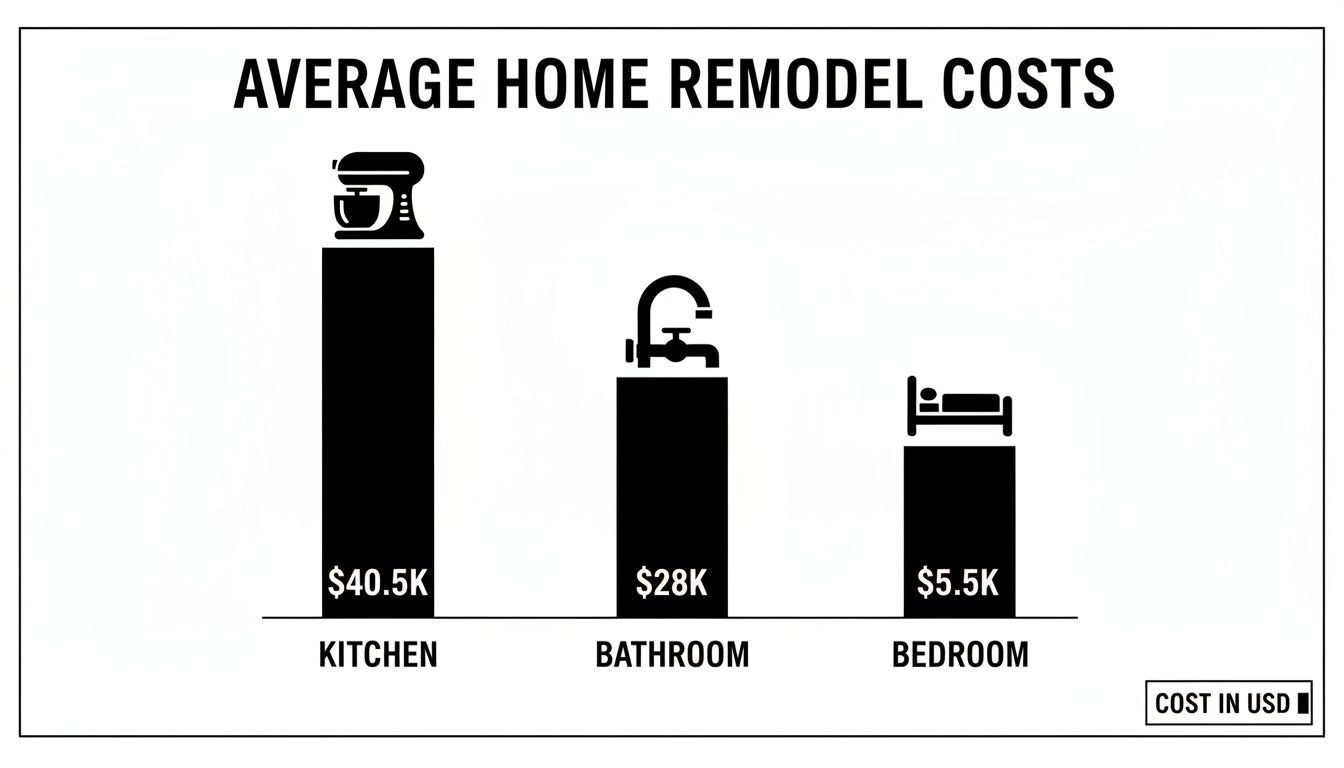
As you can see, kitchens and bathrooms consistently top the charts. Their complex mix of plumbing, electrical work, and high-value finishes naturally pushes their budgets higher.
Material and Finish Quality
With the scope locked in, your choice of materials and finishes becomes the next major player. This is where your personal taste directly meets your budget. From flooring and fixtures to countertops and cabinets, everything exists on a wide spectrum, from builder-grade basics to high-end, custom options.
Just look at countertops. A simple laminate surface might run you $20 per square foot, but a premium slab of quartzite or marble could easily climb past $150 per square foot. The same story plays out with flooring, tile, appliances, and cabinetry. These choices add up fast and can dramatically swing the final cost of a remodel.
Labor Costs and Professional Expertise
Don't underestimate labor—it typically makes up a huge chunk of any remodeling budget. The cost is driven by the level of skill required and the number of different tradespeople your project needs. A job that calls for licensed plumbers, electricians, and master carpenters is naturally going to cost more than one a general handyman can tackle.
Hiring a qualified general contractor is the best way to manage all these moving parts. While it’s an investment, a seasoned pro ensures the work is done correctly, meets all building codes, and stays on schedule, which ultimately prevents far more costly mistakes down the road. To make sure you’re partnering with the right person, it’s critical to know the right questions to ask a potential general contractor.
Geographic Location
Last but not least, where you live plays a surprisingly big role in your total project cost. Everything from labor rates and permit fees to material transportation costs can vary wildly from one city to the next.
A kitchen remodel in a high-cost area like San Francisco could easily be double what the exact same project would cost in a small town in the Midwest. Local building codes and regulations can also add layers of complexity and expense. That’s why national averages are a great starting point, but nothing beats getting detailed quotes from local professionals for an accurate, real-world budget.
A Detailed Cost Breakdown of Popular Remodeling Projects
While broad averages are a decent starting point, the real picture comes into focus when you look at specific rooms. Getting a handle on the costs for popular projects—like kitchens, bathrooms, and exterior facelifts—is how you build a budget that actually works in the real world.
Think of it like moving from a high-level map of the country to a detailed street view of your neighborhood. We're zooming in on the numbers for the projects homeowners want most, helping you see exactly where your money goes and what to expect at different price points.
The Heart of the Home: Kitchen Remodels
The kitchen is almost always the most complex—and rewarding—room to tackle, and the costs definitely reflect that. The final price tag can swing wildly based on one huge factor: are you working with the cabinets you have, or are you tearing everything out and starting over?
A budget-conscious kitchen refresh usually starts around $20,000. This approach keeps the existing layout and focuses on high-impact cosmetic changes. Think cabinet refacing, new granite or quartz countertops, and a suite of modern, energy-efficient appliances.
On the other end of the spectrum, a high-end, down-to-the-studs renovation can easily top $100,000. This kind of investment gets you fully custom cabinetry, premium materials like marble, a commercial-grade range, and major layout changes that require moving plumbing and electrical lines. For a deeper dive, check out our guide to the average cost of a kitchen remodel.
Creating a Sanctuary: Bathroom Renovations
Bathrooms are another area where your choices can make the budget swing from modest to massive. Just like with kitchens, the difference between swapping out a few fixtures and a complete overhaul is substantial. Your taste in tile, fixtures, and any layout changes will guide the final cost.
Here's a rough idea of what to expect:
- Minor Bathroom Update: For a small powder room or a light refresh, you might spend around $8,000. This could cover a new vanity, toilet, and modern light fixtures, all while keeping the plumbing exactly where it is.
- Mid-Range Bathroom Remodel: A more typical full bathroom renovation often lands between $15,000 and $40,000. This budget allows for quality tile work, a new tub or shower, semi-custom vanities, and solid-surface countertops.
- Luxury Primary Bathroom: A high-end remodel, especially if you're expanding the footprint, can easily push past $50,000. We're talking about features like a custom-tiled walk-in shower, a freestanding tub, heated floors, and designer fixtures.
Boosting Curb Appeal: Exterior Projects
The outside of your home is the first thing anyone sees, and the right updates can seriously boost its value and curb appeal. These projects often deliver a fantastic return on investment and can be as simple as a new coat of paint or as involved as a full siding replacement.
Exterior painting is one of the most cost-effective ways to get a dramatic transformation, typically costing between $6,000 and $20,000, depending on your home's size and the amount of prep work needed.
Replacing your siding is a bigger investment but pays off with better protection and energy efficiency. The cost varies widely based on the material—from affordable vinyl to premium fiber cement or wood—but often falls in a similar $6,000 to $20,000 range, though it can go higher for larger, more complex homes.
Upgrading Your Living Space: Interior Updates
Beyond kitchens and baths, other interior projects like new flooring or custom carpentry can totally change the feel of your home. The great thing about these updates is that they're scalable—you can tackle one room at a time or go for a whole-house refresh.
New flooring costs are all about the material you choose. Resilient options like vinyl or laminate are easier on the wallet, while classic hardwood or high-end tile will be a larger line item on the budget.
Custom carpentry, like built-in bookshelves or a new fireplace mantle, adds character and function that you just can't get off the shelf. These projects are priced based on their complexity, but they offer a level of personalization that makes a house feel like a home. Depending on the scope, these updates can range from a few thousand for a single room to tens of thousands for an entire floor.
How Your Location Shapes Remodeling Costs
When you're planning a remodel, one of the biggest cost drivers is something you can't change: your zip code. A home renovation simply doesn't have a universal price tag. The very same kitchen project, using identical materials and plans, can carry a wildly different cost in two different cities.
It’s a lot like the general cost of living. You instinctively know a cup of coffee or a night out costs more in a bustling city than in a quiet small town. Home remodeling operates on the same principle, shaped by the local economy, the going rate for skilled labor, and even the simple logistics of getting materials to your doorstep.
The Cost of Remodeling in Different US Cities
To bring this out of the abstract and into the real world, let's look at how the average cost of a home remodel swings across the United States. A project in an affluent community like Upper Saint Clair, Pennsylvania, might run anywhere from $50,000 to $250,000, which reflects higher property values and a strong demand for premium finishes.
Head just a few miles away to a more moderately priced area like Washington, Pennsylvania, and a similar scope of work could land somewhere between $25,000 and $120,000. The difference isn't about the quality of the work; it’s a direct result of local labor rates and market realities.
Here’s a quick breakdown of how different markets might compare for a comprehensive remodel:
- High-Cost Urban Areas: In places like San Francisco or wealthy suburbs like Fairfield County, Connecticut, you'll often see gut renovation costs start at $150 to $350 per square foot.
- Mid-Tier Metropolitan Areas: For a city like Pittsburgh, a whole-home project could range from $25,000 to $150,000, depending heavily on the specific neighborhood.
- More Affordable Markets: Locations like Wheeling, West Virginia, tend to be more budget-friendly, with typical projects falling between $25,000 and $120,000.
This is why national averages are just a starting point. Nothing beats local expertise. A contractor who lives and breathes your specific market can give you an estimate grounded in the real-world costs of labor and materials in your town, not some broad generalization.
A Look at International Remodeling Costs
Stepping outside the U.S. throws these differences into even sharper relief. The global market shows just how much local economies, supply chains, and building codes can create entirely unique cost structures. Australia, for example, is a completely different ballgame for homeowners looking to renovate.
Sydney stands out as one of the priciest renovation markets in the world. Even cosmetic updates there run $3,000–$5,000 per square meter, while high-end luxury projects can easily soar to $7,000–$10,000+ per square meter. Meanwhile, in a growing market like Brisbane, cosmetic work is closer to $2,600–$4,500 per square meter, with premium renovations hitting $6,000–$8,000+ per square meter. While Perth offers more budget-friendly options, the high cost of shipping materials to Western Australia can quickly eat into savings.
You can discover more about Australian renovation costs to see just how stark the contrast is.
This global view really hammers home why local knowledge is non-negotiable. Whether you're in Pittsburgh or Perth, your best bet is always to partner with a contractor who has deep roots in the community. They know the reliable suppliers, they navigate local permits with ease, and they have a network of trusted tradespeople—all of which lead to a smoother, more predictable, and more cost-effective project for you.
Actionable Tips for Managing Your Remodel Budget

Knowing the numbers is one thing, but actually steering your project’s budget is where the real success happens. Think of your budget less as a restrictive fence and more as a trusted roadmap that guides every decision you make. With the right approach, you can stay in control and bring your vision to life without any last-minute financial shocks.
The trick is to be an active participant in your project's financial health, not just a bystander. A few smart moves upfront can prevent small overages from turning into a full-blown budget disaster. Let’s walk through some practical tips that will help you keep costs in check.
Create a Detailed and Realistic Plan
Before anyone even thinks about picking up a hammer, you need a plan. A really, really clear one. This is your number one defense against "scope creep"—that sneaky process where small additions and changes slowly inflate your final bill. Your plan should detail every single element, from the big stuff like flooring down to the tiny drawer pulls.
Try to nail down every finish, fixture, and material choice before the project starts. The more decisions you lock in early, the less you'll be tempted by expensive, on-the-fly changes later on. A solid scope of work also allows contractors to give you a far more accurate quote, which means fewer surprises for you.
Get Multiple Itemized Quotes
Don't just take the first estimate you get. It’s absolutely crucial to get at least three detailed, itemized quotes from reputable local contractors. A vague, one-page quote is a major red flag. You want a full breakdown that shows you the costs for materials, labor, permits, and everything in between.
This isn't just about hunting for the lowest price. Laying out several itemized quotes side-by-side helps you see why the numbers are different. Maybe one contractor is using higher-end materials, or another has a more experienced (and expensive) team. This level of detail empowers you to make a smart decision based on total value, not just the bottom line.
Build in a Contingency Fund
Even with the most meticulous planning, surprises happen. It’s just the nature of remodeling, especially in older homes. You never know what’s hiding behind drywall—outdated wiring, a slow leak, or a structural issue that needs attention. This is precisely why a contingency fund isn't optional; it's essential.
A contingency fund is your project's safety net. The industry standard is to set aside 10% to 20% of your total project budget just for these "what ifs." This fund keeps a single problem from derailing your entire renovation or forcing you to cut corners on the things you really want.
If you get to the end and haven't touched it? Great! You’ve got a little extra cash. But if you do need it, you’ll be so glad it’s there.
Make Smart Material Choices
Your choices in materials and finishes will have one of the biggest impacts on the final cost of your home remodel. The good news is, this is an area where you have a ton of control to balance style, quality, and price.
Here are a few strategies to get the look you love without breaking the bank:
- Splurge and Save: Put more of your money toward the things you’ll touch and see every day—like your kitchen countertops or a beautiful front door. You can save on less noticeable items, like the hardware inside your closets.
- Look at Alternatives: If you dream of marble but not its price tag or upkeep, check out modern quartz or porcelain options that mimic the look beautifully. Likewise, luxury vinyl plank can give you the warm feel of hardwood for a fraction of the cost.
- Think Long-Term: Sometimes spending a little more upfront for a durable, low-maintenance material can save you a bundle in repairs and replacement costs down the road.
With a solid plan, you can move forward with confidence. For even more help organizing your project from start to finish, be sure to use our comprehensive home renovation checklist.
Got Questions About Remodel Costs? We've Got Answers.
As you get closer to kicking off your project, you're bound to have questions. It’s completely normal. Getting a handle on the finer points of budgeting and planning is what separates a smooth project from a stressful one. Here are some straightforward answers to the questions we hear all the time from homeowners just like you.
How Much Should I Really Budget for Surprises?
No matter how carefully you plan, old houses have a way of hiding secrets. That’s why a contingency fund isn't just a nice-to-have; it's an absolute must for any remodeling budget. This is your project’s safety net, there to catch you when you uncover things like hidden water damage behind a wall or discover the wiring isn't up to code.
We always advise clients to set aside an extra 10% to 20% of the total project cost. This buffer ensures a surprise doesn't completely derail your renovation or force you to cut corners on the things that matter most.
Think of it like insurance for your remodel. You hope you never have to use it, but if you do, you'll be incredibly glad it's there.
Is It Actually Cheaper to Renovate Multiple Rooms at Once?
It might sound strange, but yes, tackling multiple projects at the same time can save you a good chunk of money in the long run. When you bundle rooms together—say, the kitchen and two bathrooms—you create efficiencies that just aren’t possible when you space those projects out over several years.
Once our crew and subcontractors are on-site, it’s far more efficient to keep the momentum going. This approach usually leads to savings from:
- Lower Labor Costs: We're not starting from scratch each time, which cuts down on setup and teardown costs.
- Bulk Material Discounts: Ordering flooring, tile, or drywall for the whole job at once often gets you a better price.
- A More Compact Timeline: It concentrates the mess and disruption into one period, getting you back to your normal life much faster.
The initial check you write will be bigger, but the total cost is almost always less than if you'd paid for three separate projects.
Which Upgrades Give Me the Best Bang for My Buck?
If you're thinking about your home's future value, some renovations definitely pay you back more than others. The projects that consistently deliver the best return on investment (ROI) are the ones that boost curb appeal and update the most-used spaces in the house.
Kitchen and bathroom remodels are the undisputed champions here. A smart, mid-range kitchen update can often recoup a huge portion of its cost when you sell. The same goes for exterior work—new siding or a welcoming front entry makes a fantastic first impression on potential buyers and adds real value. Putting your money into these areas improves your home for you and makes it more attractive on the market.
Ready to turn these numbers into a real plan for your home? The team at Garner Construction & Maintenance is here to walk you through it with transparent pricing and real-world expertise. Contact us today to start the conversation.